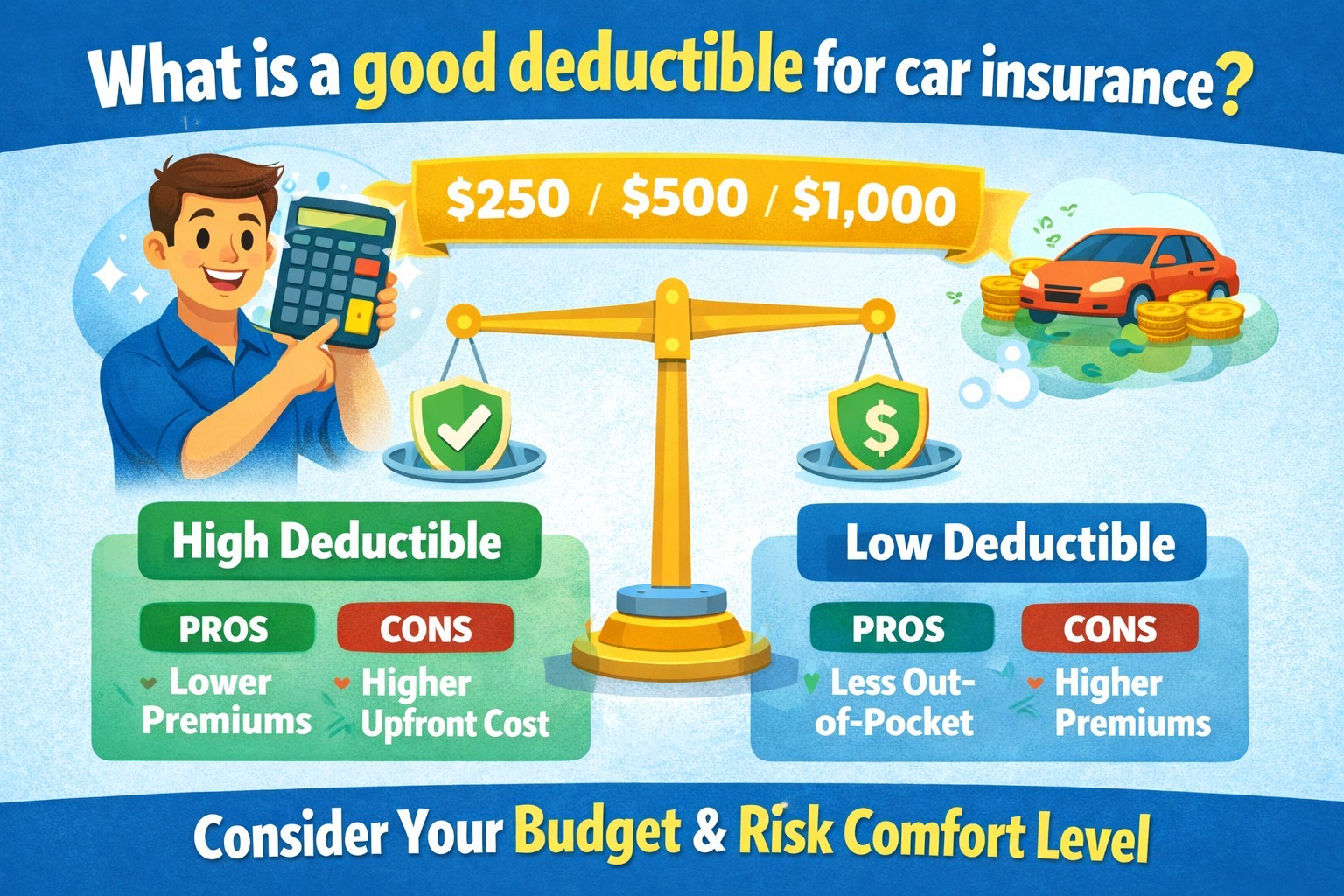
What Is a Good Deductible for Car Insurance?
Choosing the right car insurance deductible is a balancing act between your monthly budget and your financial safety net. While a lower deductible might feel safer, financial experts and industry data suggest that for most drivers, the "sweet spot" is often higher than they think. A $1,000 deductible is widely considered the optimal choice for the average driver, offering the best balance between premium savings and risk protection.
Why $1,000 is the Optimal Deductible for Car Insurance
Many drivers default to a $250 or $500 deductible, fearing a large bill in the event of an accident. However, the mathematics of insurance premiums often favor a higher deductible. When you raise your deductible from $250 or $500 to $1,000, the drop in your monthly premium is usually significant enough to "pay for itself" relatively quickly.
Consider the break-even analysis:
The Savings: By switching to a $1,000 deductible, you reduce your premiums significantly because you are assuming a small portion of the risk.
The Break-Even Point: In many cases, the money you save on premiums will equal the difference in deductible cost within 18 to 36 months.
The Long-Term Benefit: Once you pass that break-even timeline, every month of lower premiums is pure savings in your pocket.
Going higher than $1,000—such as to a $2,000 deductible—often yields diminishing returns. The additional premium savings are typically negligible compared to the doubled financial risk you would face during a claim.
The Frequency of Claims: The Odds Are in Your Favor
One of the biggest reasons a higher deductible makes financial sense is the statistical rarity of accidents for the average driver. Fear of an accident often drives people to over-insure, but the data tells a different story.
Industry statistics indicate that the average driver files a collision claim roughly once every 17.9 years.
If you are paying extra every month for a low deductible that you might only use once nearly every two decades, you are likely overpaying by thousands of dollars over your lifetime. By accepting a $1,000 deductible, you align your insurance costs with the actual statistical probability of risk.
The Hidden Cost of Small Claims
A major pitfall of having a low deductible (like $250) is the temptation to file small claims. If you have a minor incident—such as a cracked windshield or a small dent—filing a claim might seem logical because your deductible is low. However, this is often a financial trap.
The "Surcharge" Effect
Insurance companies track your claims history rigorously. When you file a claim, you risk triggering a "surcharge" on your policy. These rate increases can last for 3 to 5 years and can cost you far more than the repair bill itself.
"If you have a $50,000 loss, you need insurance. If you have a $1,000 loss, you are often better off paying out of pocket to protect your long-term rates."
The Windshield Example
Windshield replacement is a common scenario where drivers get caught. On modern vehicles equipped with Advanced Driver Assistance Systems (ADAS), a windshield replacement often requires camera recalibration, pushing costs to $1,500 or more.
If you file this claim, your insurer pays the bill, but you may lose your "claims-free" discount or see your base rate rise. Over the next three years, that rate increase could easily exceed the cost of the repair. With a $1,000 deductible, you are naturally discouraged from filing these small, rate-hiking claims, effectively forcing you to make a smarter long-term financial decision.
How to Lower Your Premiums Further
Beyond choosing the right deductible, there are several evidence-based strategies to ensure you are getting the best rate:
Maintain Continuous Coverage: Lapses in coverage can signal high risk to insurers, leading to significantly higher premiums when you re-apply.
Use Telematics Programs: Many carriers offer "safe driver" programs that track driving habits (like braking and speed) via a mobile app or device. These programs can lead to discounts of up to 30-40% for safe drivers.
Improve Your Credit Score: In most states, your credit score plays a major role in determining your insurance rate. Drivers with excellent credit scores often pay significantly less than those with poor ones.
Bundle Policies: Combining auto and home (or renters) insurance with the same carrier is one of the most reliable ways to secure a discount.
Case Study: Saving on Multi-Vehicle Coverage With Progressive
At Aaron Smith Financial Group, we recently worked with a client from a small town near our office who was insuring multiple vehicles and recreational equipment. She had four vehicles and three ATVs insured through State Farm.
During our review, we identified an opportunity to improve both her pricing and her coverage. At the time, her liability limits were set at $100,000.
After comparing available options, we moved her coverage to Progressive. As a result, she saved approximately $4,800 per year on her insurance. In addition to the savings, her liability coverage was increased from $100,000 to $250,000, providing an additional $150,000 in protection.
This change allowed the client to maintain coverage on all of her vehicles and ATVs while lowering her annual premium and strengthening her liability limits.
Conclusion: What is a Good Deductible for Car Insurance?
For most drivers, a $1,000 deductible is the smartest financial move. It lowers your monthly fixed costs, discourages you from filing minor claims that could wreck your future rates, and aligns with the statistical reality that major accidents are rare events. Instead of paying extra to the insurance company every month "just in case," consider setting that money aside in an emergency fund where it stays in your pocket until you actually need it.
More Resources from Aaron Smith

Allstate vs Progressive Insurance in South Dakota
Compare Allstate and Progressive on auto rates, home and auto bundles, coverage, discounts, and driver profiles in South Dakota.
Learn More

Geico vs Progressive Insurance in South Dakota
Compare GEICO and Progressive for personal auto, commercial auto, home bundles, claims, and discounts in South Dakota.
Learn More