How Does My Credit Score Affect Insurance?
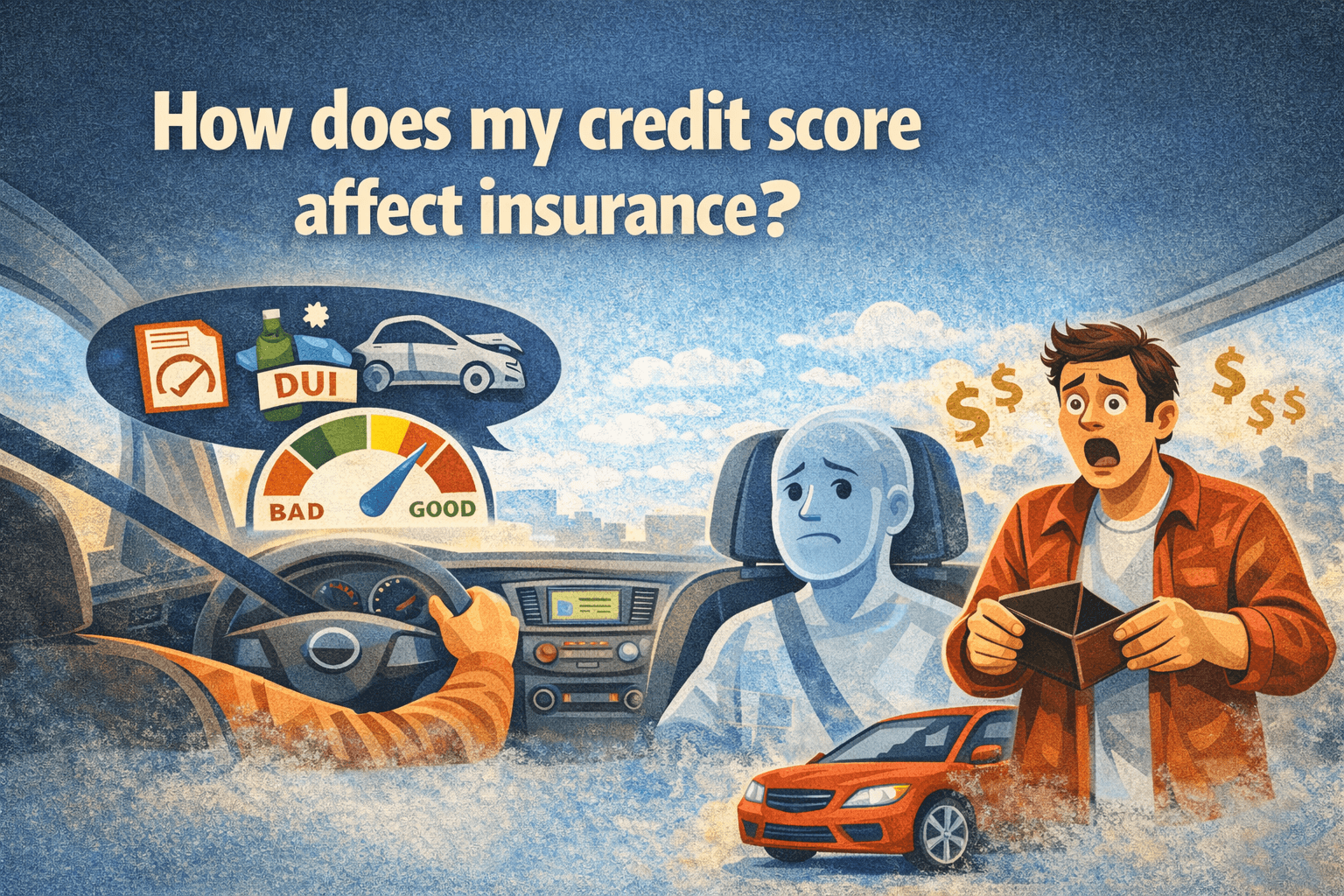
When you apply for car insurance, you might assume your rate is determined solely by your driving record—speeding tickets, accidents, and the car you drive. However, there is an "invisible passenger" in your vehicle that has a massive impact on what you pay: your credit score. How does my credit score affect insurance? For many drivers, a poor credit history can be just as damaging to their insurance premiums as a DUI or a reckless driving charge.
Insurance companies have found a statistical correlation between financial stability and filing claims. This means that even if you have a spotless driving record, a low credit score could force you to pay significantly more for the exact same coverage as someone with excellent credit. Understanding how this "secret sauce" works is the first step to taking control of your premiums.
The "Secret Sauce" of Insurance Rates
Most major insurance carriers use what is called a Credit-Based Insurance Score (CBIS). While similar to the FICO score lenders use for loans, the CBIS is calculated differently. It weighs specific financial factors to predict not how likely you are to repay a debt, but how likely you are to file an insurance claim.
Insurers analyze dozens of variables to calculate this score, including:
Payment History: Do you pay your bills on time?
Outstanding Debt: How much do you owe compared to your available credit?
Credit History Length: How long have you had active accounts?
New Credit Applications: Have you recently applied for multiple lines of credit?
Industry data suggests that drivers with lower credit scores are statistically more likely to file claims and that those claims tend to be more expensive. Because of this, insurers view credit data as a powerful predictor of risk, often giving it as much weight as your actual driving history.
How Much Does Bad Credit Really Cost?
The financial penalty for having poor credit is steep. In states where credit scoring is permitted, drivers with poor credit can pay more than double the premiums of drivers with excellent credit, even if both have identical driving records.
To put this in perspective:
Credit Tier | Impact on Premium |
Excellent Credit | Lowest available rates (Baseline) |
Average Credit | Moderate increase (approx. 20-40% higher) |
Poor Credit | Significant increase (up to 100%+ higher) |
This pricing structure often catches consumers off guard. You might lease an affordable vehicle thinking your costs will be low, only to find that the insurance payment rivals the car payment itself.
Where Credit Scores Don't Apply
Not every driver is subject to this scrutiny. Some state legislatures have determined that using credit history to set insurance rates is unfair or discriminatory. If you live in one of the following states, insurers are legally prohibited from using your credit score to determine your auto insurance rates:
California
Hawaii
Massachusetts
Michigan
In these "blind" states, your premium is based strictly on driving factors like your record, mileage, and experience. However, for the vast majority of Americans living in the other 46 states, credit remains a primary rating factor.
The High Cost of Lapses
Your credit score often goes hand-in-hand with your insurance history. One of the most damaging things you can do to your rate is let your insurance coverage lapse. Drivers who miss payments or drive without insurance are viewed as high-risk. In South Dakota, for example, approximately 9 .4% of drivers are uninsured.
If you fall into this category and try to get insured later, you will likely face a "lapse in coverage" penalty. Combined with a low credit score, this can make standard insurance unaffordable, pushing drivers toward high-risk carriers with exorbitant rates.
How to Lower Your Rate (Even with Bad Credit)
If your credit score is less than perfect, you aren't stuck with high rates forever. There are strategic moves you can make to lower your premium immediately while you work on rebuilding your credit.
1. Use Telematics (Usage-Based Insurance)
Technology allows you to prove you are a safe driver, regardless of your credit score. Programs like Progressive's Snapshot monitor your actual driving habits—braking, speed, and mileage. Safe drivers can save significantly, with average savings hovering around $145 to $322 per year upon renewal.
2. Adjust Your Deductible
Moving from a low deductible (e.g., $250) to a higher deductible (e.g., $1,000) can drastically reduce your monthly premium. While this means you pay more out of pocket in the event of a claim, the monthly savings can be substantial. Experts often recommend a $1,000 deductible as the "sweet spot" for cost-efficiency.
3. Set Up Automatic Payments (EFT)
Insurers prefer stability. Setting up Electronic Funds Transfer (EFT) for automatic monthly payments prevents you from missing a bill and damaging your insurance score further. Some carriers even offer a discount specifically for enrolling in autopay.
4. Shop with an Independent Agent
Captive agents (who sell for only one company) can only offer you one price. Independent agents can check rates across 20+ carriers. Because every insurance company in Sioux Falls uses a slightly different formula—some weighing credit more heavily than others—shopping around is the most effective way to find a carrier that is lenient on credit scores.
Case Study: Protecting FamilyAssets with Umbrella Coverage
At Aaron Smith Financial Group, we emphasize being there for our clients on their "worst day." We worked with a client whose son was involved in a tragic car accident that resulted in the death of another driver.
In South Dakota, a judgment can lead to the loss of almost everything you own, including your home and savings, with only your 401k remaining protected. Because we had previously identified this risk and set the family up with a Personal Umbrella Policy, they had the necessary protection to settle the claim and keep their home. This case highlights why we look beyond standard auto limits to ensure your family's entire financial future is secure.
Conclusion
Your credit score is a powerful lever in your financial life, and its influence extends well beyond loans and credit cards. How does my credit score affect insurance? In the insurance world, a good score is a VIP pass to lower rates, while a poor score acts as an anchor on your budget. By understanding how these scores work and utilizing tools like telematics and higher deductibles, you can mitigate the impact and keep your hard-earned money in your pocket.
More Resources from Aaron Smith

Allstate vs Progressive Insurance in South Dakota
Compare Allstate and Progressive on auto rates, home and auto bundles, coverage, discounts, and driver profiles in South Dakota.
Learn More

Geico vs Progressive Insurance in South Dakota
Compare GEICO and Progressive for personal auto, commercial auto, home bundles, claims, and discounts in South Dakota.
Learn More